Nutrition
How much protein do you need a day? A simple guide by goal
For most adults the answer is 0.8 g per kilo of body weight a day, and more if you train, are cutting calories or are over 65. Here is how to work out your number and hit it without overthinking.
By the Day Pal teamPublished 8 min read
Key takeaways
- Most healthy adults need at least 0.8 g of protein per kg of body weight a day (EFSA says 0.83 g/kg). For a 70 kg adult that is about 56–58 g.
- If you exercise regularly, sports-nutrition experts recommend 1.4–2.0 g/kg, spread across the day.
- Adults over 65 may need 1.0–1.2 g/kg to keep muscle, according to the PROT-AGE expert group.
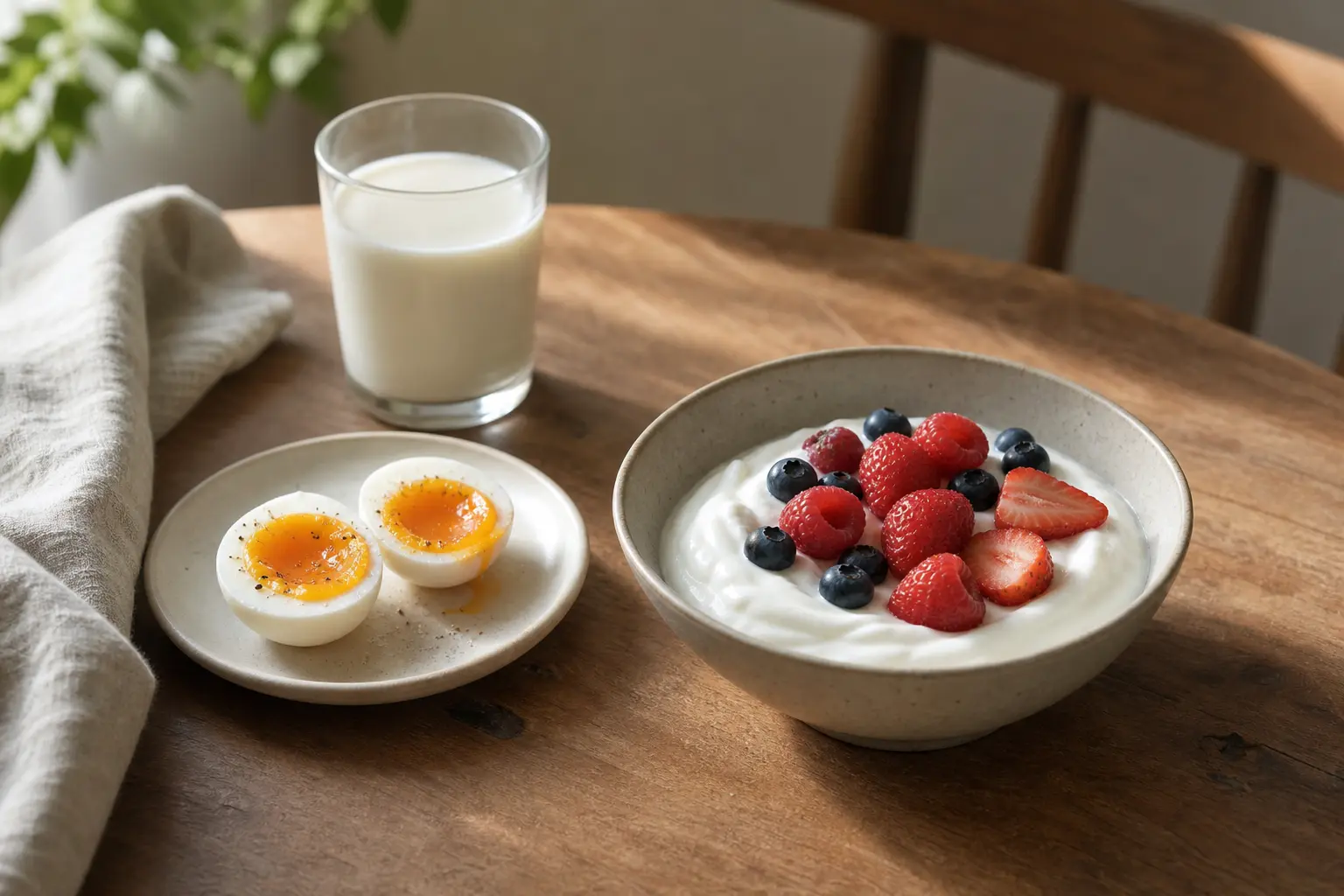
- A practical way to get there is 20–40 g per meal from foods such as eggs, Greek yogurt, chicken, fish, lentils or tofu.
What is the recommended daily protein intake?
How much protein do you need a day? The Recommended Dietary Allowance (RDA) for adults is 0.8 g of protein per kilogram of body weight per day, set by the US National Academies. The European Food Safety Authority lands on almost the same number, 0.83 g/kg, for adults of all ages. Both are designed to cover the needs of nearly every healthy adult, so treat them as a floor, not a goal that fits everyone.
To find your minimum, multiply your weight in kilograms by 0.8. If you think in pounds, divide by 2.2 first, or multiply your weight in pounds by 0.36. A 60 kg (132 lb) person needs about 48 g a day, and a 90 kg (198 lb) person about 72 g. The table below does the sums for common weights and goals.
| Body weight | 0.8 g/kg (minimum) | 1.2 g/kg (over 65, or weight loss) | 1.6 g/kg (regular training) |
|---|---|---|---|
| 50 kg (110 lb) | 40 g | 60 g | 80 g |
| 60 kg (132 lb) | 48 g | 72 g | 96 g |
| 70 kg (154 lb) | 56 g | 84 g | 112 g |
| 80 kg (176 lb) | 64 g | 96 g | 128 g |
| 90 kg (198 lb) | 72 g | 108 g | 144 g |
| 100 kg (220 lb) | 80 g | 120 g | 160 g |
Do you need more protein if you exercise?
Yes. The International Society of Sports Nutrition (ISSN) has a position stand that recommends 1.4–2.0 g of protein per kg per day for most people who exercise. Protein supports muscle repair, but only alongside training, because eating more protein on its own does not build muscle.
For a 70 kg person, that range works out to about 98–140 g a day. The table above shows the 1.6 g/kg column, a middle point for people who train regularly.
How much protein should you eat per meal?
Aim for roughly 20–40 g per meal, every 3–4 hours. The same ISSN position stand puts the useful dose at about 0.25 g per kg of body weight, or 20–40 g in absolute terms, and suggests spreading it evenly rather than eating most of it at dinner.
If most of your protein arrives at dinner, moving some of it to breakfast or lunch is a simple fix. A 75 kg person aiming for 1.4 g/kg needs about 105 g a day, which works out to about 35 g at each of 3 meals, or 25–30 g at each of 4 meals and snacks.
How much protein do you need to lose weight?
If you are cutting calories, aim for about 1.2–1.6 g/kg a day. That much protein helps you hold on to muscle and can make meals more filling. A review in the American Journal of Clinical Nutrition found that higher-protein meals made people feel modestly fuller, though they did not eat less at the next meal. The authors conclude that diets in that range, and possibly 25–30 g per meal, may help with appetite and weight management, mainly for people who stick to them.
In the ISSN position stand, resistance-trained people who were cutting calories kept more lean mass at much higher intakes (about 2.3–3.1 g/kg), but most people do not need to go that far. If you also lift weights while cutting, the 1.4–2.0 g/kg range for exercise applies.
How much protein do you need after 65?
Most adults over 65 need 1.0–1.2 g/kg per day, more than the general RDA. Muscle mass naturally declines with age, and protein helps slow that loss. The PROT-AGE Study Group recommends 1.0–1.2 g/kg for healthy older adults, at least 1.2 g/kg for those who exercise, and 1.2–1.5 g/kg for many older adults with acute or chronic illness. The group was convened by the European Union Geriatric Medicine Society.
The exception is older adults with severe kidney disease (an eGFR below 30) who are not on dialysis. They are usually advised to limit protein and should follow their doctor’s advice instead.
Which foods are high in protein?
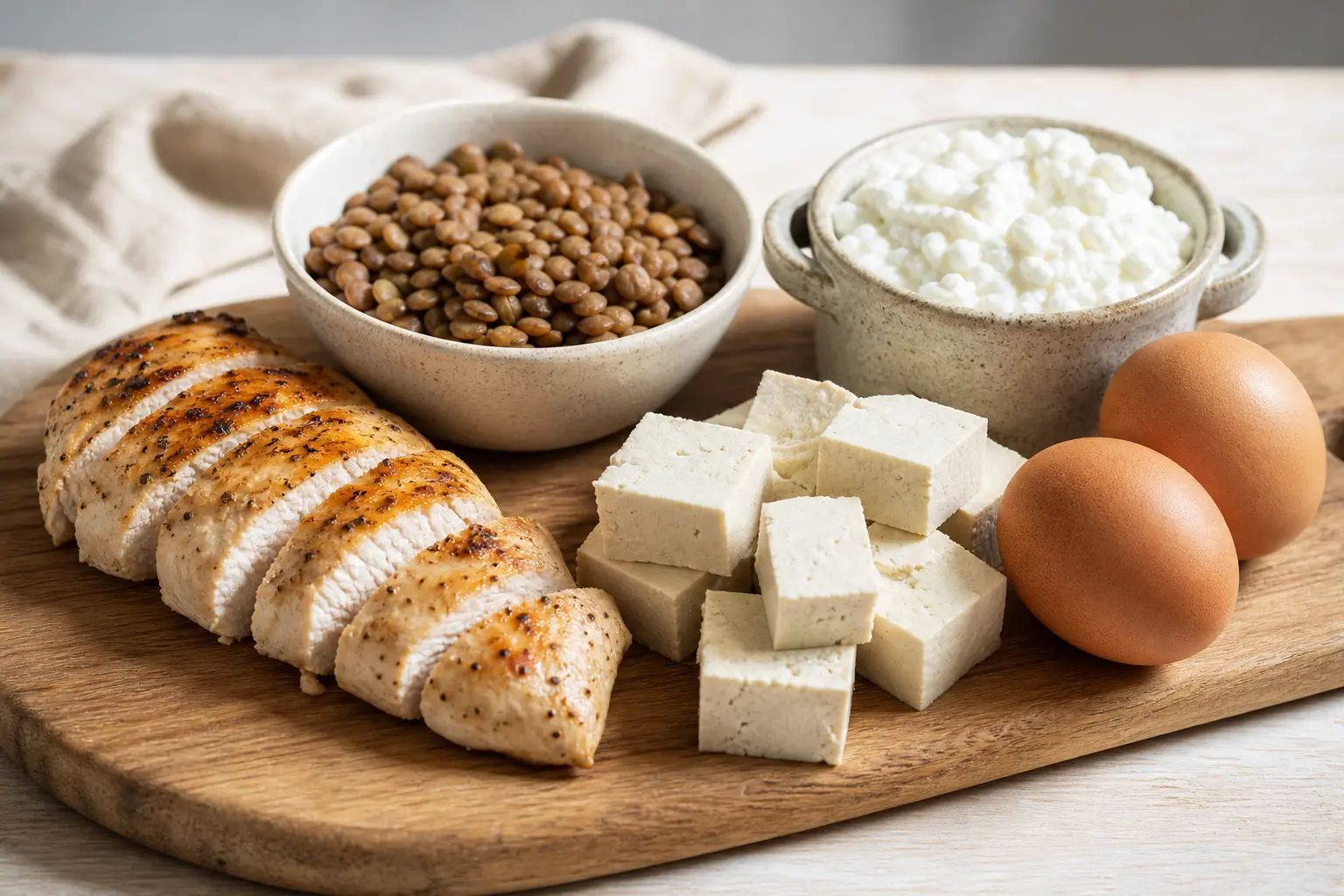
Meat, fish, eggs, dairy, soy foods and pulses are the richest everyday sources. The figures below are approximate values from USDA FoodData Central, the US government’s food composition database. Brands and cooking methods vary, so check the label when you have one.
| Food | Protein per 100 g |
|---|---|
| Chicken breast, cooked | 31 g |
| Tofu | 8 g (regular) to 17 g (firm) |
| Egg | 13 g (about 6 g per large egg) |
| Cottage cheese, low fat | 12 g |
| Greek yogurt, plain nonfat | 10 g |
| Lentils, cooked | 9 g |
| Milk | 3.3 g per 100 ml |
| Peanut butter | 22 g |
Per 100 g is useful for comparing foods, but you eat portions. Here is what a typical serving of each gives you.
- Chicken breast, cooked, 120 g37 g
- Firm tofu, 150 g26 g
- Cottage cheese, low fat, 150 g19 g
- Cooked lentils, 200 g18 g
- Greek yogurt, plain nonfat, 170 g17 g
- 2 large eggs13 g
- Milk, 250 ml8 g
- Peanut butter, 2 tbsp (32 g)7 g
Approximate USDA values; brands and cooking change them.
Source: U.S. Department of Agriculture
To check a food that isn’t listed here, you can search a free calorie and macro tracker before you eat it.
Can you get enough protein on a plant-based diet?
Yes. You do not need animal products to get all the protein you need, and the balance of protein foods over the whole day matters more than combining them at every meal, according to MedlinePlus, from the US National Library of Medicine. The Academy of Nutrition and Dietetics position holds that appropriately planned vegetarian and vegan diets are nutritionally adequate at every stage of life, athletes included.
In practice that means a protein food at each meal. Lentils, beans, chickpeas, tofu, tempeh, soy milk and wholegrains all count. The NHS advice on a vegan diet also recommends eating some beans, pulses and other proteins as part of a varied vegan diet. Beans, lentils and chickpeas are also among the richest sources in our guide to how much fiber you need per day.
What does a 100 g protein day look like?
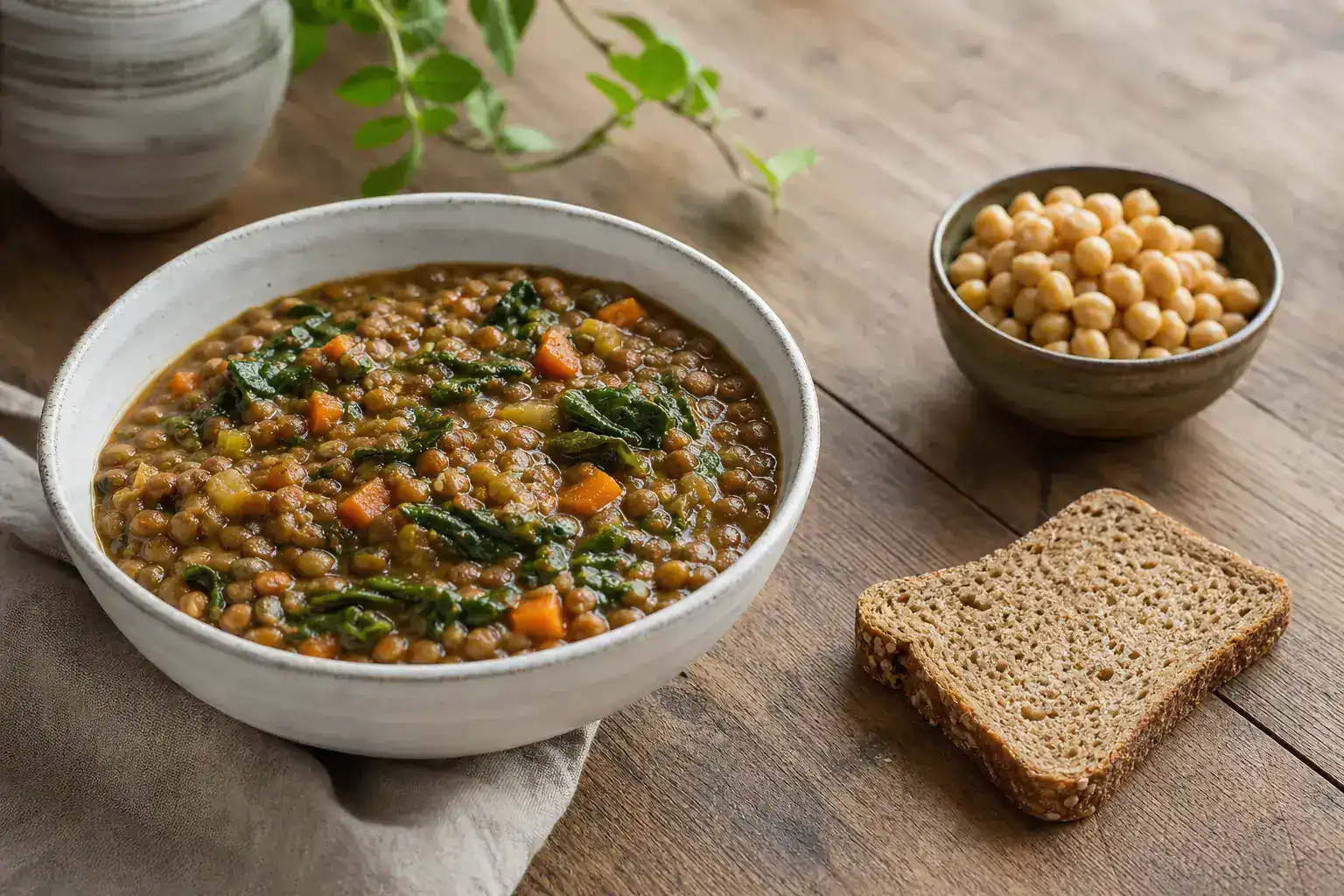
Here is one way a 70 kg person who trains a few times a week could reach about 100 g, or roughly 1.4 g/kg, without protein shakes. The totals count only the protein foods named, so sides such as rice, bread and vegetables add a little more.
- Breakfast: 2 eggs and a 170 g pot of Greek yogurt with fruit (about 30 g).
- Lunch: 120 g of chicken breast with rice and salad (about 37 g).
- Snack: a 250 ml glass of milk and toast with 2 tablespoons of peanut butter (about 15 g).
- Dinner: a lentil stew made with 200 g of cooked lentils and vegetables (about 18 g).
Can you eat too much protein?
For healthy, active adults, higher intakes appear safe. The ISSN position stand found no sign of kidney or liver harm from higher protein diets in healthy people who exercise. Protein you don’t need is not stored as muscle. Your body uses it for energy, and at the 4 kcal per gram used on US nutrition labels it still counts towards your calories.
Kidney disease changes the picture. The National Institute of Diabetes and Digestive and Kidney Diseases explains that some people with chronic kidney disease need a moderate protein intake, while eating too little risks malnutrition. If you have kidney disease, are pregnant, or follow a medically supervised diet, agree a protein target with your doctor or a registered dietitian.
How do you hit your protein number every day?
Keep it simple. Three habits cover most of the work for most people:
- Work out your number once from the table above, using the column that matches your age, your goal and how much you train.
- Build each meal around a protein food, such as eggs, yogurt, chicken, fish, tofu or lentils, so you reach 20–40 g without thinking about it.
- Check a day or two of real meals. If one meal falls well short, fixing that one meal closes much of the gap.
You don’t need to weigh every meal to do that check, as our guide to counting calories without weighing food explains. An AI photo calorie counter such as Day Pal shows a meal’s protein from a photo, and you can download Day Pal for iPhone and start with the free food search.
If you only change one thing, start with tomorrow’s breakfast. If it has less than 20 g of protein, adding a 170 g pot of Greek yogurt puts about 17 g more on the plate, and the rest of the day gets easier to fill.
Questions people ask
How much protein do I need a day to build muscle?
Most people who strength-train do well with 1.4–2.0 g of protein per kg of body weight a day, spread over 3–4 meals, according to the International Society of Sports Nutrition. For a 75 kg person that is about 105–150 g.
Is 100 g of protein a day too much?
Not for most healthy adults. For an 80 kg person, 100 g is 1.25 g/kg, below the 1.4–2.0 g/kg range recommended for active people, and the ISSN position stand found no sign of kidney or liver harm from higher intakes in healthy people. If you have kidney disease, ask your doctor first.
How do I calculate my protein needs in pounds?
Multiply your weight in pounds by 0.36 to get the 0.8 g/kg minimum. A 150 lb person needs about 54 g a day. For an active target, multiply by 0.64–0.9 instead.
Can I get enough protein on a plant-based diet?
Yes, with some planning. Lentils, beans, chickpeas, tofu, tempeh, soy milk and wholegrains all add protein. According to MedlinePlus, the balance of protein foods over the whole day matters more than combining them at every meal.
About Day Pal
- Day Pal is an AI calorie tracker and macro counter, available on the App Store for iPhone.
- You log meals by snapping a photo, typing or saying what you ate in your own words, or searching 13,000+ foods grounded in USDA data.
- It tracks calories, protein, carbs and fat, plus water, weight and workouts.
- An AI coach reads today’s diary to answer questions and suggest meals and workouts you can log in one tap.
- Free to start: food search and logging by hand are free forever, and each device gets 10 free AI actions.
- Day Pal Pro, monthly or annual, keeps AI logging and the coach going beyond the free actions under a fair-use policy. There is no free trial, and the App Store shows the price in your currency.
- Available in 11 languages, Arabic included.
- Meal photos are analysed and then dropped, never stored on Day Pal’s servers.
- Day Pal is a wellness app, not medical advice.
Sources
- Dietary Reference Intakes for Energy, Carbohydrate, Fiber, Fat, Fatty Acids, Cholesterol, Protein, and Amino Acids, National Academies of Sciences, Engineering, and Medicine
- EFSA sets population reference intakes for protein, European Food Safety Authority
- International Society of Sports Nutrition Position Stand: protein and exercise (2017), Journal of the International Society of Sports Nutrition
- Evidence-based recommendations for optimal dietary protein intake in older people: a position paper from the PROT-AGE Study Group (2013), Journal of the American Medical Directors Association
- FoodData Central, U.S. Department of Agriculture
- The role of protein in weight loss and maintenance (2015), American Journal of Clinical Nutrition
- Protein in diet, MedlinePlus, U.S. National Library of Medicine
- Position of the Academy of Nutrition and Dietetics: Vegetarian Diets (2016), Journal of the Academy of Nutrition and Dietetics
- Healthy Eating for Adults with Chronic Kidney Disease, National Institute of Diabetes and Digestive and Kidney Diseases
Keep reading
Calorie tracking
How to count calories without weighing your food
You don’t need a food scale to track calories well. A US label can legally understate calories by up to 20%, and a steady estimate matters more than a precise one. Here are 6 ways to estimate portions that hold up.
7 min read