Calorie tracking
How to count calories without weighing your food
You don’t need a food scale to track calories well. A US label can legally understate calories by up to 20%, and a steady estimate matters more than a precise one. Here are 6 ways to estimate portions that hold up.
By the Day Pal teamPublished 7 min read
Key takeaways
- A packaged food in the US can legally hold up to 20% more calories than its label says, so even weighed food is an estimate.
- In a review of 22 studies, recording what you ate was consistently linked with more weight loss, though the evidence was rated weak.
- A serving of meat is about the size of your palm or a deck of cards, and ½ cup of cooked rice is about a tennis ball.
- In a 2012 lab study, calories estimated from meal photos came within about 1% of weighed food on average.
Do you need to weigh your food to count calories?
No. You can count calories without weighing your food by sizing portions against your hand or everyday objects, logging meals from a photo or a short description, and estimating the same way every day. The rest of this guide shows how to do each one well.
A scale is the most precise tool you can own, but a perfect weight is only as good as the calorie figure you multiply it by. The US Food and Drug Administration regulates the Nutrition Facts label, and under the US labelling rule, 21 CFR 101.9, a packaged food is misbranded only when its calories exceed the label by more than 20%. In practice a product can hold up to 20% more calories than the box says. Restaurant meals and home cooking have no label at all.
That is why a reasonable estimate you record every day beats a precise one you give up on after a week. A 2011 systematic review in the Journal of the American Dietetic Association looked at 22 studies published between 1993 and 2009, 15 of them on recording what people ate. The link between this kind of self-monitoring and weight loss was consistent across them. The authors still rated the evidence as weak because of how the studies were designed, and in all but 2 of them most participants were white women.
Logging as you eat also beats relying on memory. In a 1992 study in the New England Journal of Medicine, 10 adults with obesity who reported eating very little without losing weight under-reported what they actually ate by 47% on average, measured over 14 days. It was a small, specific group, but it shows how easily food slips out of a record kept from memory.
How can you estimate portions with your hand?
Compare the food with your palm, your fist or an object you already know. MedlinePlus, the US National Library of Medicine’s health site, lists these comparisons, and once you know them you can size up a plate in a few seconds.
| Food | Amount | About the size of |
|---|---|---|
| Meat or poultry | 1 serving | The palm of your hand or a deck of cards |
| Fish | 3 oz (84 g) | A checkbook |
| Cheese | 1 serving | A pair of dice |
| Cooked rice or pasta | ½ cup (80 g) | A rounded handful or a tennis ball |
| Chopped raw fruit or vegetables | 1 cup (90 g) | Your fist or a baseball |
| Apple or orange | 1 medium | A tennis ball |
| Dried fruit or nuts | ¼ cup (35 g) | A golf ball or a small handful |
| Peanut butter | 2 tbsp (32 g) | A ping-pong ball |
| Baked potato | 1 medium | A computer mouse |
Your hand goes everywhere with you, which makes it the easiest reference at a restaurant or at a friend’s table, and tracking calories when you eat out covers the rest of a meal you did not cook. Hands differ in size, so treat these as a starting point and use the same reference every time, so your estimates stay comparable from one day to the next.
Can you count calories from a photo?
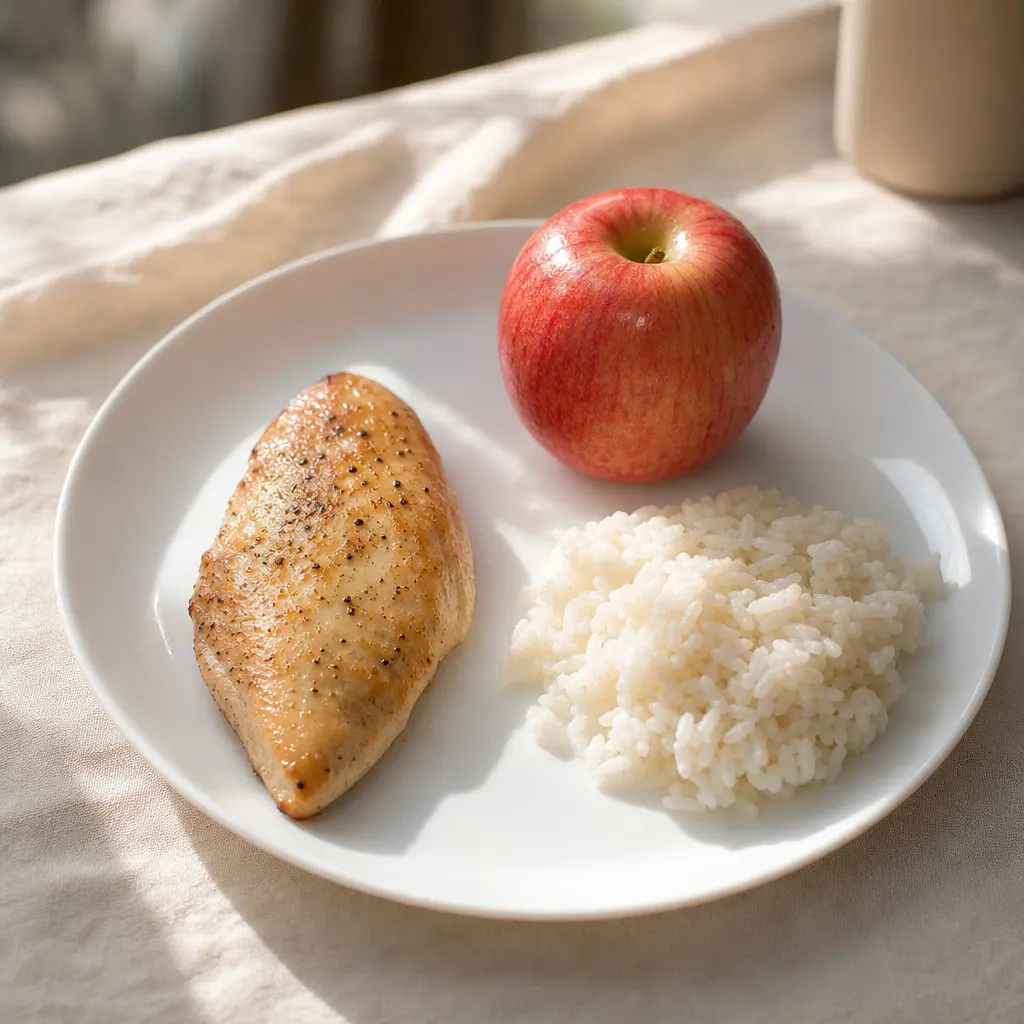
Yes, and a 2012 study found photo estimates close to the real intake. Researchers at Pennington Biomedical Research Center tested the Remote Food Photography Method in a study published in Obesity, where trained analysts estimated calories from photos people took of their own meals. With 50 adults taking part, most of them women, the photo estimates came in 1.2% below the weighed food at lab buffet meals.
Over 6 days of normal life, they came in 3.7% below the real intake, about 152 kcal a day. That comparison used doubly labelled water, a lab method that measures how much energy the body actually burns. Neither gap was statistically significant.
- Lab meals, compared with weighed food1.2 %
- 6 days of normal life, compared with doubly labelled water3.7 %
Average underestimate in the Remote Food Photography Method study (2012). Neither difference was statistically significant.
Source: Obesity
AI photo logging applies the same idea, with software estimating the meal instead of a trained analyst. It is still an estimate, so glance at the result and fix anything that looks off, especially oil, sauces and food hidden under something else. If you are still choosing an app, this guide to Cal AI alternatives gives 5 checks to run before you pay. In Day Pal, meal photos are analysed and then dropped, never stored on its servers.
Can you log a meal by describing it?
Yes. “Two eggs, toast with butter and a coffee with milk” already holds most of what a calorie estimate needs. Write it down or say it right after you eat, while you still remember the small things that are gone by evening, such as the second slice, the splash of cream or the handful of nuts.
If you would rather pick each item yourself, a food database does the same job. A free calorie tracker with a searchable food list lets you match each part of the description to a real entry and set the amount.
How do you learn to eyeball portions?
Measure your usual foods for a few days, then go by eye. MedlinePlus suggests using measuring cups for a couple of days until you are more practised at eyeballing. Aim them at the foods you eat most, such as your breakfast bowl, your usual portion of rice or your glass of juice.
You only need to do it once per food. The authors of the photo study name misjudged portion size as a main source of error in self-reported food records, so a few days with a measuring cup gives you a reference for the part that goes wrong most often. The same researchers found that even trained people improve only modestly, so expect it to help, not to remove the error.
Which calories are easiest to miss?
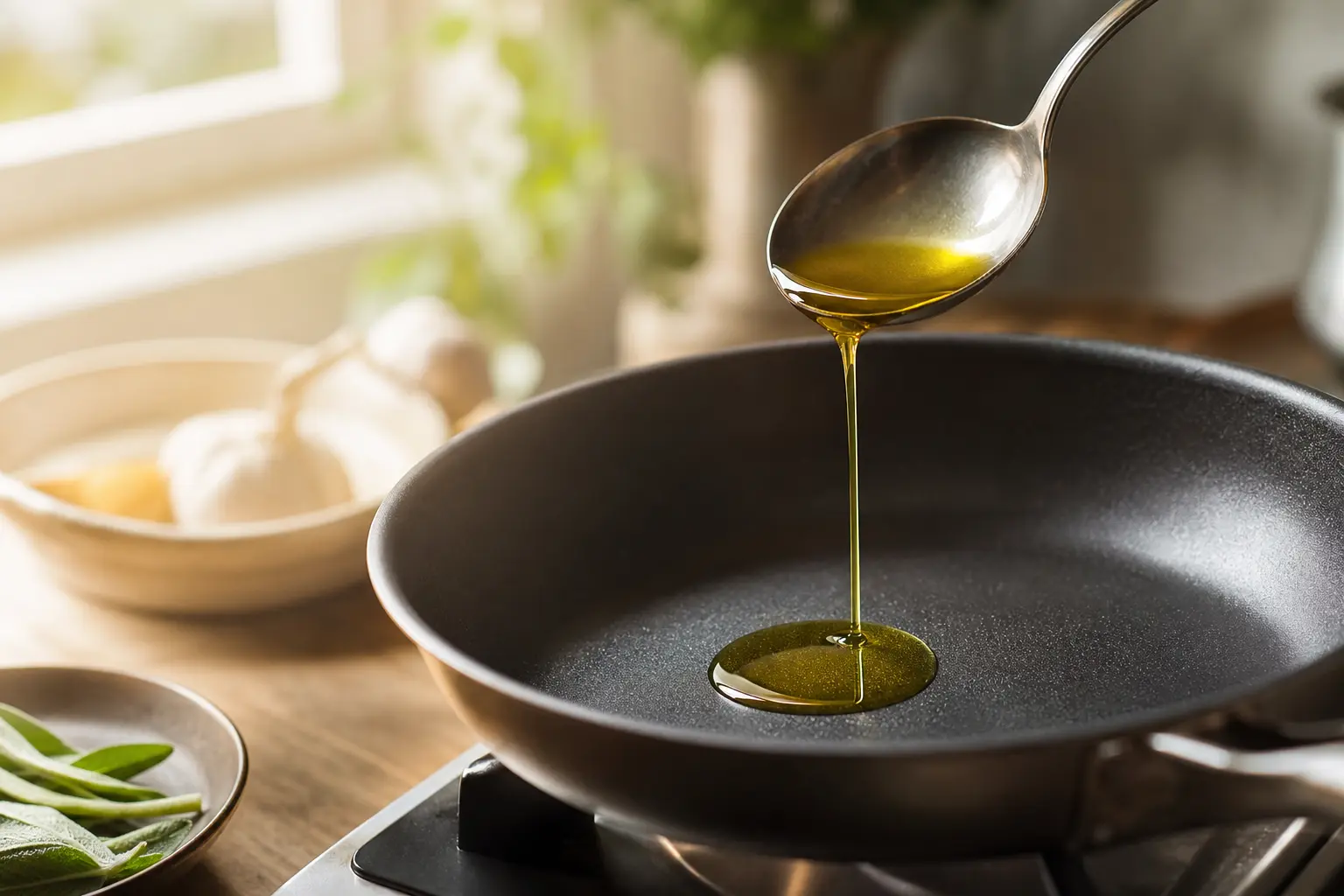
Fats, sauces and drinks. They rarely look like a meal, yet USDA FoodData Central, the US government’s food composition database, shows how much they carry. A tablespoon of olive oil holds about 119 kcal, so 2 tablespoons in a pan add about 240 kcal before any food goes in.
- Cooking oil and butter: about 120 and 100 kcal per tablespoon.
- Sauces and dressings: regular mayonnaise is about 94 kcal per tablespoon, and pesto, creamy dressings and peanut sauce add up too.
- Drinks: a 12 fl oz (355 ml) can of regular cola is about 155 kcal and a cup of orange juice about 112 kcal. Milky coffees and alcohol count as well.
- Tastes and bites: finishing the kids’ plate or picking while you cook.
- Olive oil, 1 tbsp119 kcal
- Butter, 1 tbsp102 kcal
- Mayonnaise, 1 tbsp94 kcal
- Peanut butter, 2 tbsp191 kcal
- Cola, 1 can (355 ml)155 kcal
- Orange juice, 1 cup (248 ml)112 kcal
Values from USDA FoodData Central (SR Legacy).
Source: U.S. Department of Agriculture
How accurate do your estimates need to be?
Consistent matters more than exact. If your estimates run a little high or a little low but you estimate the same way every day, the trend still tells you what is happening. Compare your log with your weight over 2 or 3 weeks, and if the trend is not moving the way you want, adjust portions of the most calorie-dense foods first.
Calories are only part of the picture. If you are also trying to build or keep muscle, check how much protein you need a day and estimate it the same way.
What is the simplest way to start?
Log your next meal as you eat it, with a photo or a sentence, and don’t worry about getting it perfect. Size the portions with your hand, add the oil and the drink, and log the same way tomorrow and the day after. A rough record you keep is worth more than a perfect one you abandon. If you want a photo or a sentence to do the logging, download Day Pal for iPhone.
Questions people ask
How accurate is eyeballing portions?
Less precise than weighing. Misjudging portion size is one of the main sources of error in self-reported food records, according to researchers who tested photo-based logging. Calibrating once with a measuring cup helps a little, though trained people improve only modestly. Using the same references every day keeps the error steady, which is what you need to see a trend.
Are calorie counting apps accurate?
They are as accurate as what goes in. Database values are averages, and photo estimates can miss hidden oil or sauce, so review entries that look off. For following a trend, a consistent estimate is enough.
Can you lose weight counting calories without a scale?
It can help. A review of 22 studies found that recording what you eat was consistently linked with weight loss, though the evidence was rated weak. No method guarantees a result, so if your weight trend doesn’t move after a few weeks, review your portions of calorie-dense foods first.
What is the easiest way to track calories?
The one you will keep doing. For most people that means logging as they eat, with a photo or a quick description, rather than trying to rebuild the whole day at night.
About Day Pal
- Day Pal is an AI calorie tracker and macro counter, available on the App Store for iPhone.
- You log meals by snapping a photo, typing or saying what you ate in your own words, or searching 13,000+ foods grounded in USDA data.
- It tracks calories, protein, carbs and fat, plus water, weight and workouts.
- An AI coach reads today’s diary to answer questions and suggest meals and workouts you can log in one tap.
- Free to start: food search and logging by hand are free forever, and each device gets 10 free AI actions.
- Day Pal Pro, monthly or annual, keeps AI logging and the coach going beyond the free actions under a fair-use policy. There is no free trial, and the App Store shows the price in your currency.
- Available in 11 languages, Arabic included.
- Meal photos are analysed and then dropped, never stored on Day Pal’s servers.
- Day Pal is a wellness app, not medical advice.
Sources
- 21 CFR 101.9, Nutrition labeling of food (paragraph g), U.S. Food and Drug Administration, via eCFR
- Self-monitoring in weight loss: a systematic review of the literature (2011), Journal of the American Dietetic Association
- Validity of the Remote Food Photography Method (RFPM) for estimating energy and nutrient intake in near real-time (2012), Obesity
- Portion size, MedlinePlus (U.S. National Library of Medicine)
- FoodData Central, U.S. Department of Agriculture
- Discrepancy between self-reported and actual caloric intake and exercise in obese subjects (1992), New England Journal of Medicine
Keep reading
Nutrition
How much protein do you need a day? A simple guide by goal
For most adults the answer is 0.8 g per kilo of body weight a day, and more if you train, are cutting calories or are over 65. Here is how to work out your number and hit it without overthinking.
8 min read